
Subsidiarity: Why Decisions Should Stay Close to Citizens
It is one of the least known words in European law and one of the most important. Subsidiarity says that decisions should be taken as close to the citizen as possible, and only moved upward when there is a good reason. Here is where the idea comes from, how it works in the EU today, and why it deserves to be taken far more seriously.
An old idea with a simple core
The principle is older than the European Union. It was formulated most clearly in Catholic social teaching, in Pope Pius XI’s 1931 encyclical Quadragesimo Anno, which warned that it is “an injustice” for a larger and higher association to claim what smaller and lower communities can do themselves. Its roots go further back, to the self-governing towns, guilds, water boards and cantons of medieval and early modern Europe. In the Dutch tradition, the Calvinist idea of “sphere sovereignty” made a related point: family, church, school and business each have their own domain, which the state should respect.
The core is simple. The family before the municipality, the municipality before the province, the province before the nation, and the nation before Brussels. A higher level should help, which is what the Latin subsidium means, but not replace.
Subsidiarity in the EU treaties
The principle entered EU law with the Maastricht Treaty of 1992. Today it is set out in Article 5 of the Treaty on European Union. In areas that are not the EU’s exclusive competence, the Union may act only “if and in so far as the objectives of the proposed action cannot be sufficiently achieved by the Member States, either at central level or at regional and local level, but can rather, by reason of the scale or effects of the proposed action, be better achieved at Union level.”
Article 5 is paired with proportionality: even where the EU may act, its action must not go beyond what is necessary. And it rests on the principle of conferral: the EU only has the powers the member states have given it in the treaties.
The yellow and orange cards
The Lisbon Treaty of 2009 gave national parliaments a direct role in policing subsidiarity, through Protocol No 2. Every draft EU law is sent to national parliaments, which have eight weeks to object with a “reasoned opinion”.
- Yellow card. If objections reach one third of the votes allocated to national parliaments (one quarter for justice and home affairs), the Commission must review the proposal and justify its decision.
- Orange card. Under the ordinary legislative procedure, if objections reach a simple majority, the Commission must review, and the Council or Parliament can stop the proposal.
The yellow card has been triggered three times: in 2012 against a proposal on the right to strike (the “Monti II” regulation, which the Commission withdrew), in 2013 against the creation of the European Public Prosecutor’s Office (which went ahead), and in 2016 against the revision of the Posted Workers Directive (which also went ahead). The orange card has never been triggered. Many observers, including the European Parliament’s own research service, have noted that eight weeks is a short time for national parliaments to coordinate, and that the Commission retains the last word.
The Court of Justice can annul EU acts for breaching subsidiarity, but it has never done so. In practice, subsidiarity is mostly a political principle, and it is only as strong as the politicians and parliaments willing to use it.
Why it matters in practice
Better decisions. Local authorities know their roads, rivers and farms. A nitrogen rule designed for the sandy soils of the Peel may make little sense on the clay of Friesland. The more rules are written for an entire continent, the more they must be either very general or very wrong somewhere.
Accountability. Citizens can name their mayor and their provincial deputies, and vote them out. Responsibility for an EU directive, drafted by the Commission, amended in trilogue and transposed by a national ministry, is much harder to place. When everyone is responsible, no one is.
Legitimacy. When people feel decisions are made far away by people they cannot reach, trust in all institutions falls. The farmer protests of recent years, which we chart in our timeline, are partly a revolt against distance.
Experimentation. Different regions trying different solutions is how good policy is discovered. A single European rule ends the experiment before it begins.
Living examples
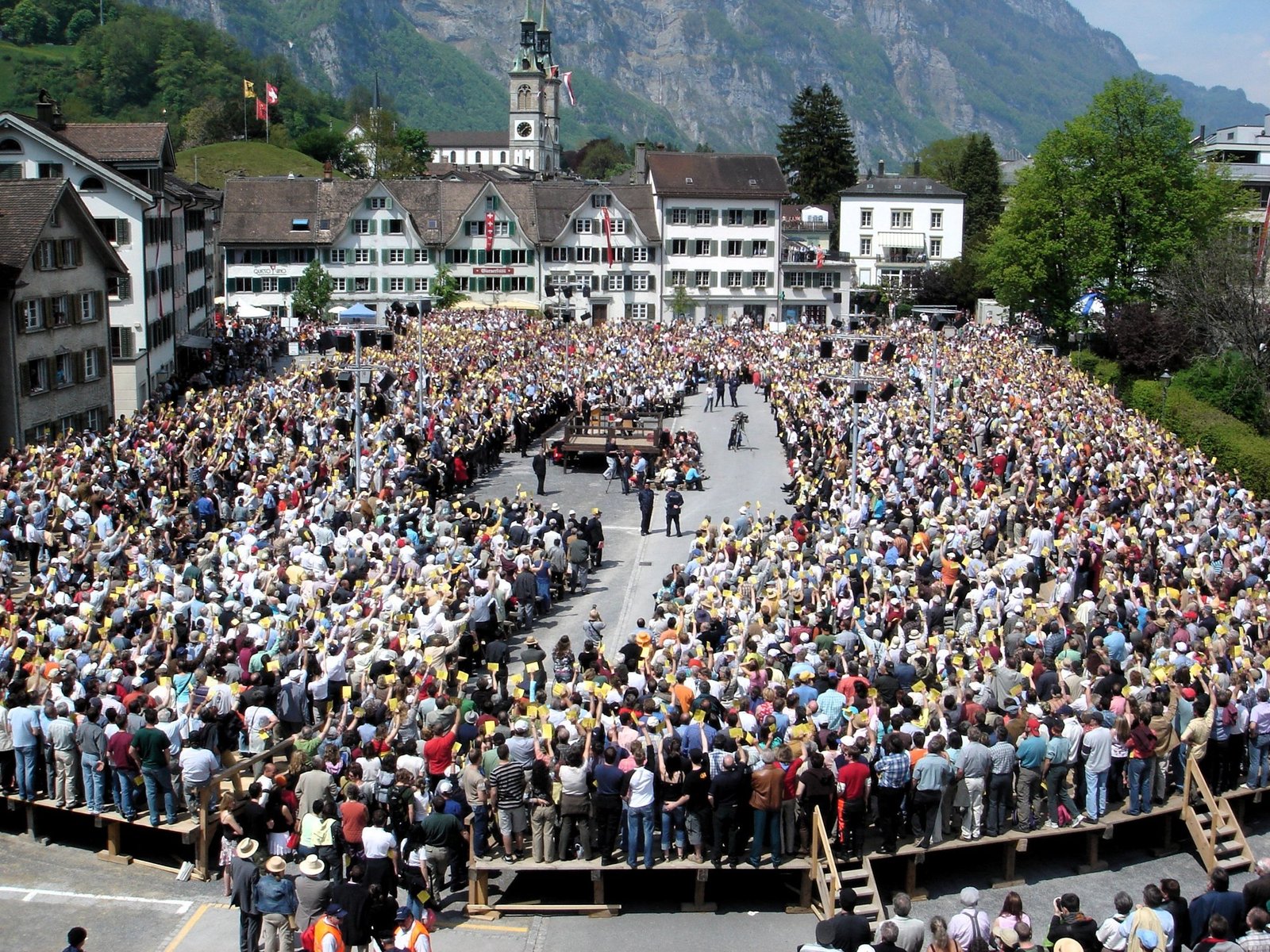
Switzerland offers the clearest model. Its cantons have wide powers over taxes, schools and policing, and citizens vote several times a year in referendums. In the canton of Glarus, citizens still gather each spring in the open air, at the Landsgemeinde, to vote on laws by show of hands. It is noisy, slow and very democratic.
Closer to home, the Dutch water boards (waterschappen), some of which date from the 13th century, are among the oldest democratic institutions in Europe. They have their own elections and their own taxes, and they keep the polders dry. They show that local self-government is not nostalgia. It is a practical way of running things that has worked for eight hundred years.
A fair word for the other side
Subsidiarity is not a reason to reject all cooperation. Some problems really do cross borders: a single market needs common rules, polluted rivers flow downstream, and defence is cheaper together. The treaty test is the right one. The question is not whether the EU should act, but whether it must, and whether its action is the lightest that will work. That question should be asked honestly every time, rather than assumed.
What could be done
- Extend the eight-week deadline for national parliaments to twelve weeks, so they can coordinate.
- Lower the yellow-card threshold, and give the orange card real force.
- Require the Commission to publish a clear, specific subsidiarity assessment for every proposal, not boilerplate.
- At home, give provinces and municipalities real budgets and real choices, rather than only the duty to implement rules made elsewhere.
The bottom line
Subsidiarity asks a modest question with large consequences: who is closest to the problem, and can they solve it? A Europe that took that question seriously would be more trusted, more varied and more free. It is written into the treaties already. It just needs people willing to insist on it.
Sources: Treaty on European Union, Article 5, and Protocol No 2 (EUR-Lex); Quadragesimo Anno (Vatican); European Parliament fact sheets on subsidiarity and national parliaments; public records of the 2012, 2013 and 2016 yellow-card procedures.
Featured image: The open-air Landsgemeinde in Glarus, Switzerland, 2006. Photo: Adrian Sulc, CC BY-SA 3.0, via Wikimedia Commons.